Concept renders for Artemis Base Camp by French scientific illustrator Pierre Carril, commissioned by the European Space Agency (ESA) in 2019. The concept depicts Artemis Base Camp having dome-shaped human habitats covered with a layer of lunar regolith for radiation and impact protection, interconnected transparent geodesic domes housing hydroponic gardens for food and oxygen generation, and vast deployable solar arrays capturing near-constant sunlight at the lunar south polar region to power the outpost. Astronauts in ESA-marked spacesuits oversee robotic construction rovers building the lunar base.
NASA's international Artemis Base Camp, with ESA as a major partner, is a planned long-term outpost on the lunar south pole, envisioned as the cornerstone of sustainable human exploration under the Artemis program, with establishment targeted for the 2030s. Situated near craters like Shackleton for access to water ice in permanently shadowed regions and areas of near-continuous sunlight for solar power, the initial base would include a fixed Foundation Surface Habitat to accommodate up to four astronauts for stays of one to two months, a pressurized rover for extended surface traverses, an unpressurized Lunar Terrain Vehicle for mobility, power systems (including potential nuclear options), in-situ resource utilization for producing essentials like oxygen and propellant from lunar regolith, and supporting infrastructure for scientific research and technology testing to pave the way for Mars missions. As of early 2026, with Artemis II crewed preparations advancing toward a March launch, the concept remains NASA's blueprint for transitioning from short landings to permanent lunar presence.
A competing project – International Lunar Research Station (ILRS) – is being developed under Chinese leadership and targets the lunar south pole region in the 2030s, starting robotic before permanent habitability post-2035 and full expansion by ~2050.
Showing posts with label ESA. Show all posts
Sunday, February 8, 2026
Sunday, December 19, 2021
Map of shallow subsurface water in Valles Marineris on Mars
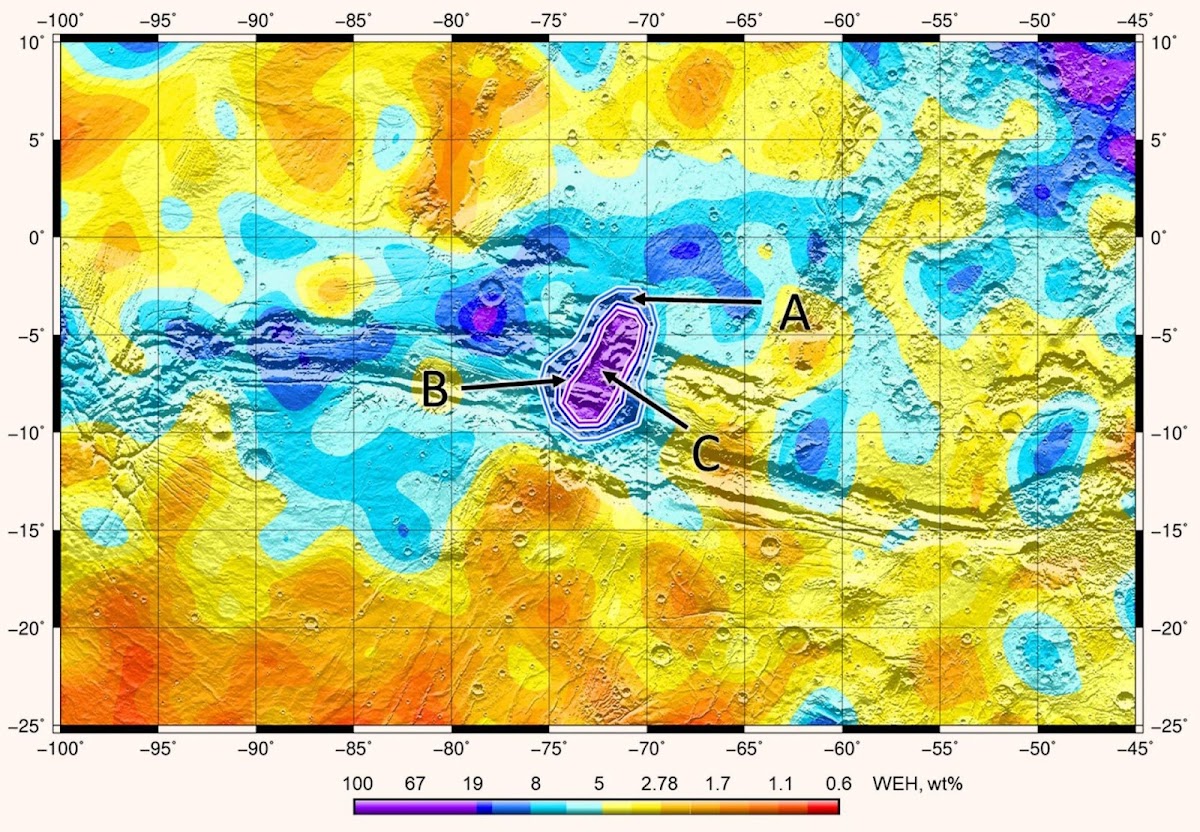
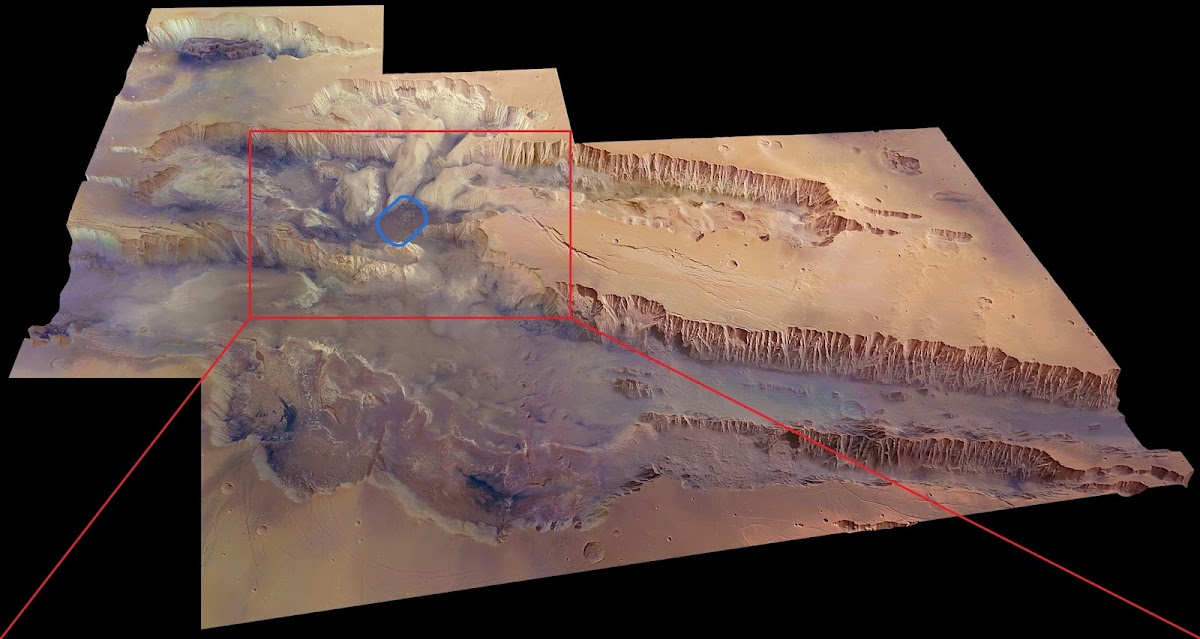
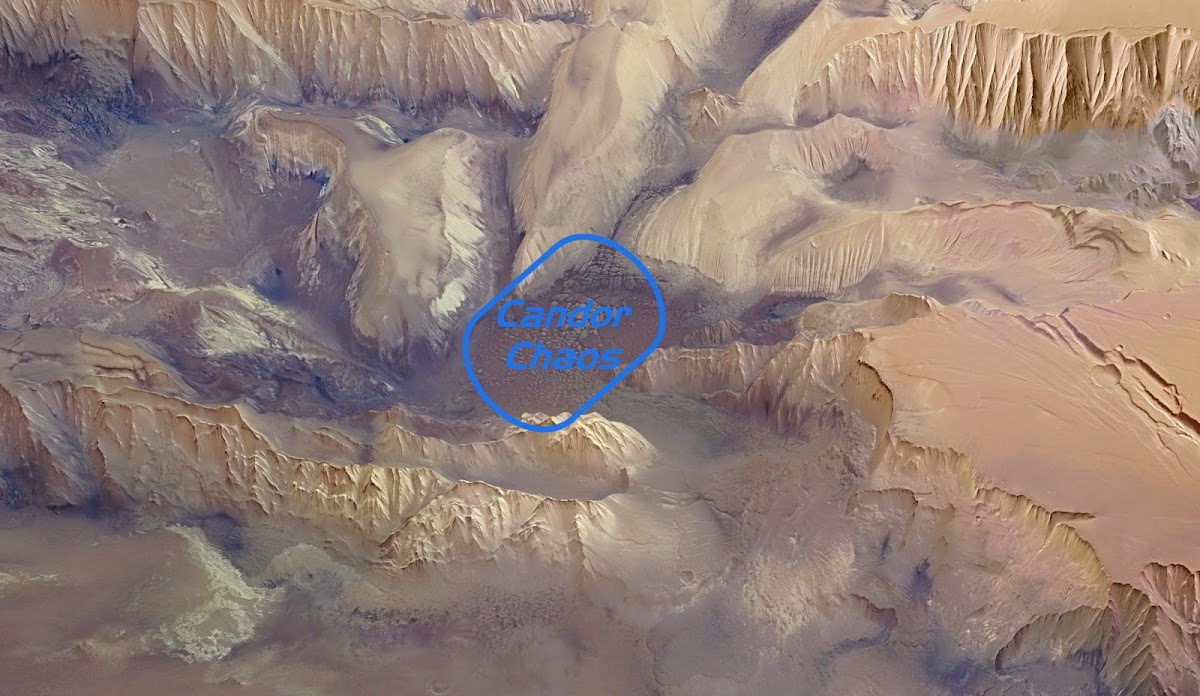
On December 15 scientists from Space Research Institute of the Russian Academy of Sciences in Moscow, Russia revealed a discovery of an area with an unusually large amount of hydrogen in the Valles Marineris canyon system on Mars. Assuming the hydrogen is bound into water molecules, as much as 40% of the near-surface material in Candor Chaos region appears to be water. The discovery was made by neutron detector FREND on ESA&Roscosmos's ExoMars Trace Gas Orbiter orbiting Mars since October 2016. FREND is mapping the distribution of hydrogen in the uppermost meter of the planet’s surface. Hydrogen indicates the presence of water, being one of the constituents of the water molecule; it can also indicate water absorbed into the surface, or minerals that were formed in the presence of water.
While water is known to exist on Mars, most is found in the planet’s cold polar regions as ice. Typically water ice is not found exposed at the surface near the equator, as temperatures there are not cold enough for exposed water ice to be stable. Minerals seen in this part of Mars typically contain only a few percent water, much less than is evidenced by these new observations. “We found a central part of Valles Marineris to be packed full of water – far more water than we expected. This is very much like Earth’s permafrost regions, where water ice permanently persists under dry soil because of the constant low temperatures,” told one of the scientists involved in the study.
These are very inspiring discoveries for the future human colonization of Valles Marineris region we have imagined in our speculative Mars Colonization Timeline!
⇧ In the area C up to 40% of the near-surface material appears to be composed of water (by weight).
HERE is global-scale map of shallow subsurface water distribution on Mars published in 2019.
While water is known to exist on Mars, most is found in the planet’s cold polar regions as ice. Typically water ice is not found exposed at the surface near the equator, as temperatures there are not cold enough for exposed water ice to be stable. Minerals seen in this part of Mars typically contain only a few percent water, much less than is evidenced by these new observations. “We found a central part of Valles Marineris to be packed full of water – far more water than we expected. This is very much like Earth’s permafrost regions, where water ice permanently persists under dry soil because of the constant low temperatures,” told one of the scientists involved in the study.
These are very inspiring discoveries for the future human colonization of Valles Marineris region we have imagined in our speculative Mars Colonization Timeline!
⇧ In the area C up to 40% of the near-surface material appears to be composed of water (by weight).
The most water-rich area in Valles Marineris region is located in Candor Chaos:
HERE is global-scale map of shallow subsurface water distribution on Mars published in 2019.
Tuesday, June 25, 2019
ESA's base on Mars by Martin Kornmesser
Picture of the Day 25/6/2019 - Concept image of European Space Agency's (ESA) base on Mars by German graphic designer Martin Kornmesser.
Thursday, April 11, 2019
Map of shallow subsurface water distribution on Mars
On March 10 ESA has revealed the first results from ExoMars Trace Gas Orbiter orbiting Mars since October 2016. Among the data there is the best map of shallow subsurface water distribution on Mars ever created. The map is made by orbiter's neutron detector FREND mapping the distribution of hydrogen in the uppermost metre of the planet’s surface. Hydrogen indicates the presence of water, being one of the constituents of the water molecule; it can also indicate water absorbed into the surface, or minerals that were formed in the presence of water.
- Blue areas - more water
- Orange areas - less water
Sunday, December 23, 2018
Ice deposit in Korolev crater
Water ice deposit in Korolev crater at the northern polar plain on Mars. This recent image is taken by the European Space Agency's (ESA) Mars Express orbiter. Korolev crater is 81 kilometers (51 miles) in diameter and naturally traps the cold air in it continuously replenishing the ice deposit with fresh layers of ice. The ice sheet is up to 1.8 kilometers (1.1 miles) thick and it is estimated the crater holds about 2200 cubic kilometers (530 cubic miles) of water ice.
(Open link in new tab to view ⇩ in HD wallpaper resolution)
Sunday, October 28, 2018
Elongated cloud on Mars at Arsia Mons
On September 13 European Space Agency’s (ESA) Mars Express orbiter spotted an elongated cloud on Mars near the Arsia Mons - a dormant shield volcano 12 miles high. The cloud stretches for about 930 miles (1500 kilometers) and hasn't dissolved for over a month. That's nothing extraordinary - similar clouds has been spotted on Mars in 2009, 2012 and 2015 at winter season. The giant Martian volcanoes, rising high into the atmosphere, are playing a role into creation of those kind of clouds.
Wednesday, April 25, 2018
Pressurised rover concept by ESA for Mars500
Picture of the Day 25/4/2018 - Pressurised rover concept by European Space Agency (ESA) for Mars500 study.
Subscribe to:
Comments (Atom)